What if Your Normal Isn’t Healthy?
A conversation with Dr. Matthew Campbell
I drove to Oxford, Mississippi without really knowing what I was going to get.
I knew Matt, but I didn’t know this version of Matt.
Thirty years ago, he was the president of the fraternity I pledged at Clemson. Back then, the lessons were about leadership, brotherhood, and surviving college.
This time, we were sitting across from each other talking about something very different.
How to actually live.
Not how to succeed. Not how to make money.
How to live.
And somewhere early in the conversation, whether he said it directly or I just felt it sitting there between us, the question became obvious.
What if your normal isn’t healthy?
“We’ve forgotten how to live like humans.”
At one point, Matt said something that framed the entire conversation.
“Modern humans haven’t forgotten how to succeed. We’ve forgotten how to live like humans.”
That line stayed with me.
Because if you step back and look at it, most of us are doing fine on paper.
Careers. Families. Responsibilities. Progress.
But underneath it, there is this low level hum.
Tired.
Distracted.
A little off.
And we just assume that is part of life.
The part nobody talks about
I spend a lot of my time talking to families about money.
Investments. Portfolios. Planning. Retirement.
That’s Retirement IQ.
But there is always a deeper question.
What’s the point?
What’s the point of building all of it if your life doesn’t feel right?
Matt didn’t come at it from a financial angle.
He came at it from something much more basic.
“What if the biggest misalignment… starts with self-care?”
Not spa days.
Not bubble baths.
Something more primal.
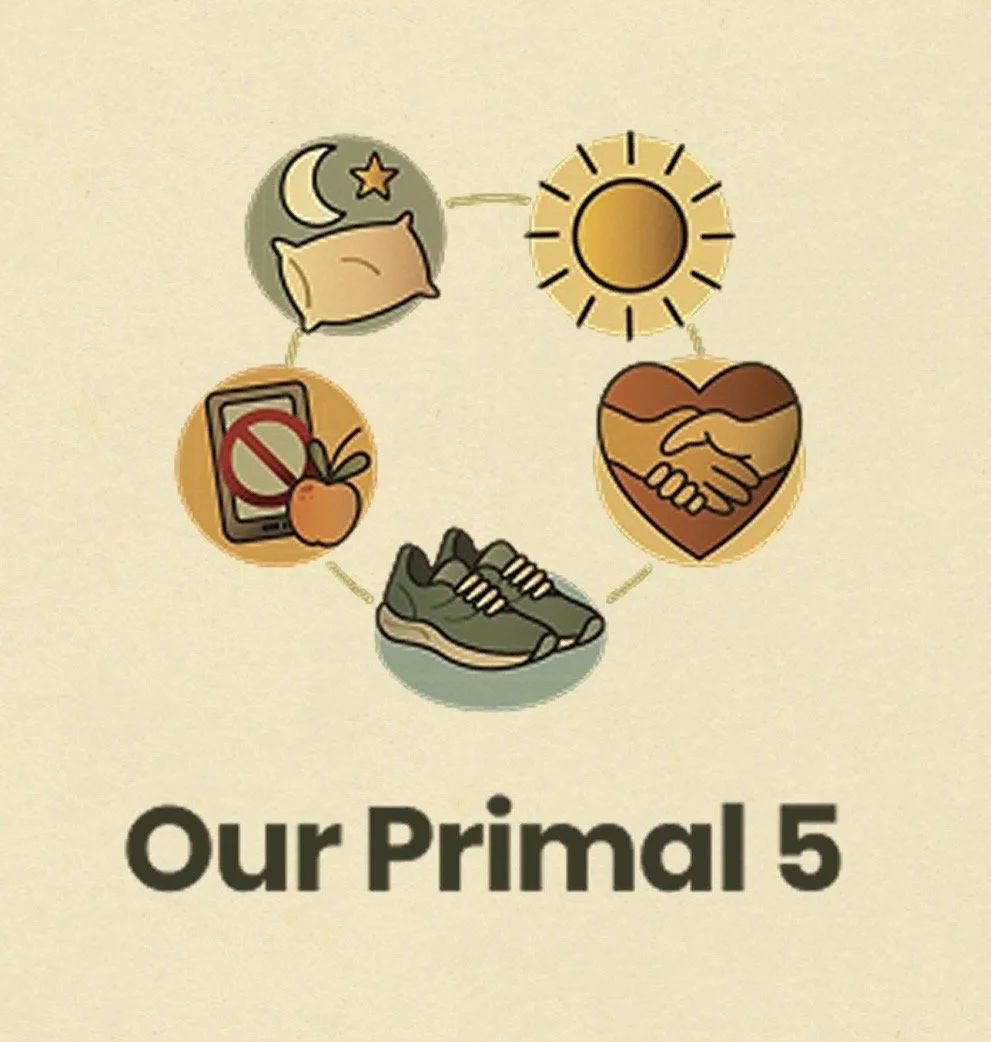
Sunlight.
Sleep.
Movement.
Connection.
And what we choose to Consume.
Five things.
That’s it.
This is where it’s different
This isn’t another book filled with ideas. It’s a workbook.
That distinction matters.
Because most people don’t have an information problem. They have an implementation problem.
We already know we should sleep better, exercise, spend time outside, and be more present.
That is not new.
The problem is it never leaves the level of conversation.
It lives as fodder at dinner tables and cocktail parties.
Matt built this differently.
Five behaviors.
Five weeks.
One focus at a time.
It is structured to help you apply it to your life.
Actually apply it.
Not just talk about it.
And he is building an Our Primal 5 app to sit alongside the workbook.
Not as another distraction, but as a way to reinforce it.
Something that helps you stay consistent.
Track the behaviors.
Keep the momentum going.
Because knowing what to do has never really been the problem.
Doing it consistently is.
The part that made me pause
There was a moment where he said something that made me stop.
“We’re so accustomed to this depleted state… that it feels normal.”
Most people never question their baseline.
They just accept it.
Until you change one thing.
That is where this approach works.
It does not ask you to do everything.
It asks you to start.
Start with one
I started experimenting with it before I went to Oxford and when I got back home.
Nothing extreme.
Sat outside in the morning with coffee instead of inside. Took the dogs for a walk instead of simply opening the back door. Cut off coffee and caffeine after noon. Put my phone out of reach before I went to bed. Read myself to sleep instead of watching TV.
That was it.
And the difference was not subtle.
It is amazing how a few little changes can shift your mood and mindset.
Momentum begets momentum
This is where it really clicked for me.
It builds.
Sunlight sets your circadian rhythm and improves sleep.
Sleep improves mood.
Mood makes movement easier.
Movement reduces stress.
It stacks.
It compounds.
At first it feels small.
Then it starts to snowball.
And the more you do it, the more you want to keep doing it.
Keep it simple
We got into movement, and I expected something more complicated.
Programming. Structure. Optimization.
Nope.
“Walk. Thirty minutes.”
That was the answer.
Simple.
Which is exactly why most people overlook it.
“If you can’t be you, that’s a red flag.”
We started talking about relationships.
Not the easy kind. The real kind.
The ones people stay in too long. The ones they explain away.
And he said it in a way that leaves no room for interpretation.
“If you can’t be you, that’s a red flag.”
No overthinking.
Just truth.
The thing we are all underestimating
Connection.
We talk about it like it is optional.
It is not.
Half of people report being in a lonely state.
Half.
And when you start improving the other areas, this one becomes more obvious.
You start wanting real connection.
Not just proximity.
The part where it gets uncomfortable
Then we got into what we consume.
Not just food.
Everything.
Social media.
News.
Alcohol.
“It is a dopamine capture… we are the product, not the consumer.”
That is the reality.
And most of us are not as in control of it as we think.
“Behavior leads, feelings follow.”
If there was one takeaway from the entire conversation, this was it.
“The ideal healthy behavior is behavior leads, feelings follow.”
Most people wait until they feel like doing something.
Then they act.
This flips it.
Act first.
Let the feeling catch up.
That is the difference between knowing and doing.
Why this works
I asked him where someone should start.
His answer was simple.
“Pick one.”
That is it.
Because this is not about perfection. It is about progress.
And once you start, it builds.
Momentum begets momentum.
Why this matters
Thirty years ago, Matt was teaching leadership in a fraternity house.
Today, he is teaching something a lot more fundamental.
How to live in a way that actually works.
None of this is new.
We already know it. We just don’t do it.
That is the gap.
And that is why the workbook matters.
It closes the gap between knowing and doing.
And now, with the app alongside it, there is even less room to hide behind good intentions.
I spend my days helping people build and preserve financial capital.
That matters.
But Life EQ helps us build the kind of life where that capital actually matters.
Because what good is wealth if you are exhausted, disconnected, and constantly distracted?
What you think is normal might not be.
And small changes, done consistently, can change everything.
Get the Workbook
Learn More About Dr. Matthew Campbell
Oxford, Mississippi: Where This Conversation Began
Never Miss an Update from Retire Southern