
Commander’s Palace: A Master Class in Hospitality
The iconic aqua building sits in New Orleans’ Garden District, directly across from Lafayette Cemetery. Ti Adelaide Martin told me her mother, Ella Brennan, used to joke that you should never open a restaurant across from a cemetery because you don’t get much walking traffic. Years later, Ti went back to her with an update. The cemetery had become a destination. Tours were running constantly. Visitors were pouring in.
“I told her, guess what, they’re doing tours of the cemetery and they’re coming in droves,” Ti said.
They laughed about it for years. What was once a punchline became another reminder that in New Orleans, even the quietest places eventually reveal their life.
Sitting at her office conference table during Mardi Gras season, the city buzzing just outside the windows, Ti felt exactly like you would hope the steward of one of America’s great restaurants would feel. Grounded. Present. Unrushed. More interested in the person sitting across from her than her next engagement.
“We care about the whole experience,” she told me. “Not just the food. We care before you ever get here.”
That sentence explains nearly everything.
The House That Ella Built
Ti grew up influenced by Commander’s Palace long before she ever worked inside it.
Her mother is widely regarded as one of the most influential restaurateurs in American history. But Ti does not speak about Ella in terms of legend first.
“She was one of the greatest restaurateurs in America,” Ti said. “But she was also one of the best mothers. I won the lottery.”
Ella was loving. She was demanding. She was unsparing in her honesty.
“I’d work real hard all night, and then go over to her house, and she and my Aunt Dottie would tell me it was the worst restaurant in America and everything I was doing wrong,” Ti laughed. “They were tough.”
But Ella also understood something essential about leadership.
“One thing she was really good at is you have to learn to stop and ring bells and whistles when something good happens. Don’t just let it pass by quickly. Stop for a moment and celebrate.”
That instinct still lives inside Commander’s Palace today. Awards matter not because of ego, but because they represent thousands of quiet acts of excellence repeated daily.
Ti’s favorite awards memory isn’t about chefs or headlines. It is about service.
When Ella accepted the James Beard Award for Best Service in America, her acceptance speech was a single statement.
“I accept this for every damn captain and waiter in America.”
Standing ovation.
For Ti, that moment still defines the soul of Commander’s Palace.



Finding Her Way Back to Restaurants

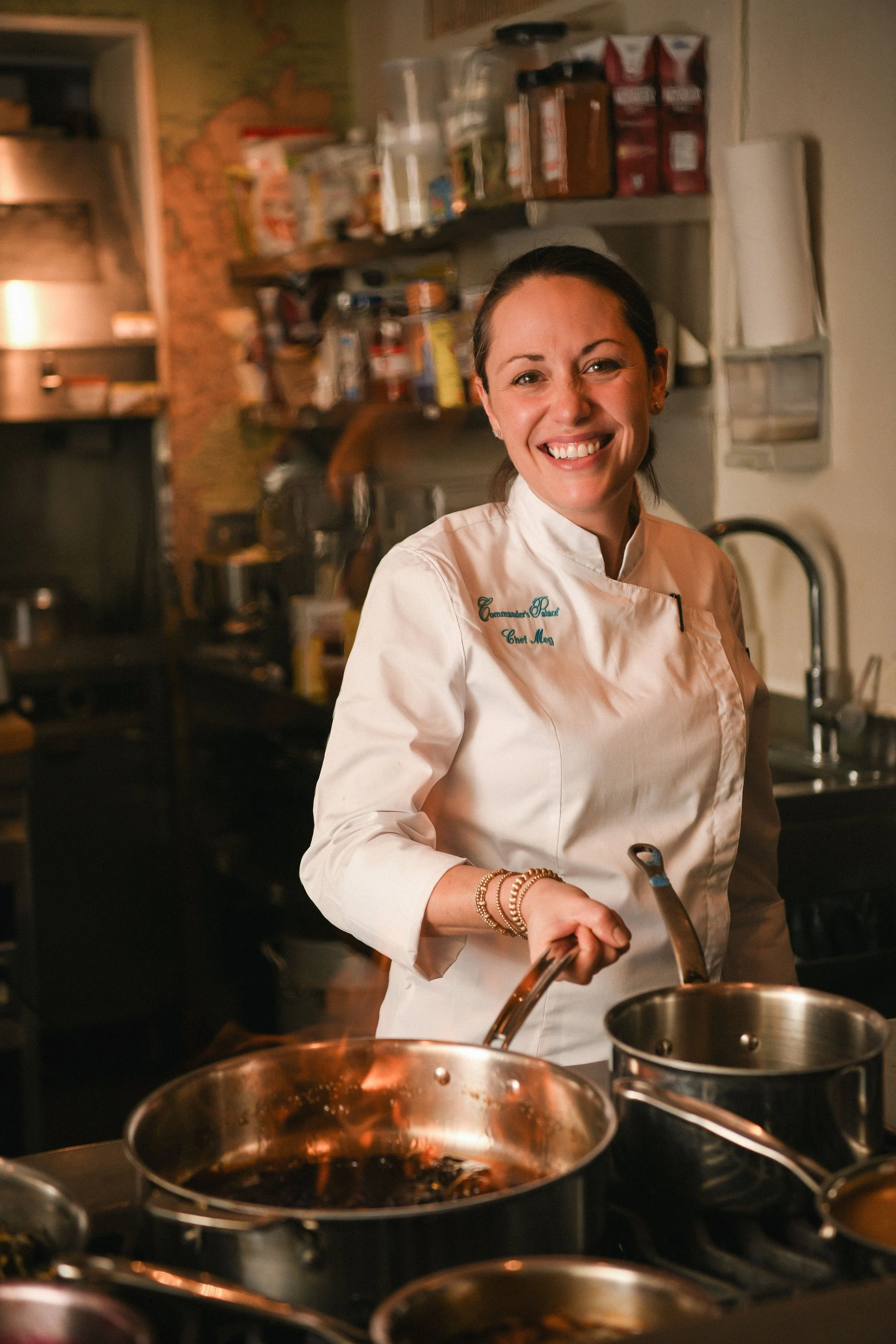
Chef’s Table menu signed by Meg Bickford
Ti studied business at Southern Methodist University, then returned to New Orleans for her MBA at Tulane. She worked in commercial real estate in Houston. “I didn’t think I was going into the restaurant business,” she told me. “I’m just fascinated with business, period.”
Her return came suddenly.
“I got a phone call from my Aunt Dottie that my mother was going to have heart surgery the next day. I drove home, and on the way I thought, what are you doing, stupid?”
She began working alongside her mother in the mid-1980s. Not as an executive. Not as a proprietor. But as someone learning the rhythms of restaurants from the ground up.
She built a food products company called Creole Cravings that was eventually sold to McCormick. Later, she and her cousin Dickie Brennan opened Palace Café. After a family reorganization, she found herself back at Commander’s Palace.
“It all did just kind of evolve,” she said. “But I love restaurants. I like being in them, going to them, reading about them, writing about them. I just love restaurants.”
That love still shows.
A Fanatical Commitment to Fundamentals
Commander’s Palace operates on a deceptively simple philosophy.
“A fanatical commitment to the consistent execution of the fundamentals,” Ti said.
Then she translated.
“Is the hot food hot? Is the cold food cold? Is the bathroom clean? Then I’ll talk to you about your fancy new dish.”
Hospitality here is not accidental. It is engineered.
Guests are greeted with body language, not nods. Chairs are pulled. Names are remembered. Servers pause to let guests pass, even while balancing heavy trays. Valets are treated as hospitality professionals, not traffic controllers.
“We work on body language,” Ti said. “We work on the guest having a passage.”
The goal is invisible service.
When it works, guests stop noticing the machinery and start noticing each other. Conversation flows. Time stretches. Meals become memories.
“It’s not about us. It’s about you.”
The kitchen follows the same philosophy. Commander’s Palace continues to evolve within Creole and Cajun traditions, sourcing heavily from Louisiana and the surrounding region.
“This is where Creole and Cajun crashed right here in this kitchen,” Ti said. “It’s endless.”
Playfulness exists. Innovation exists. But identity always leads.
Teaching Hospitality as a Profession


Ti’s passion for hospitality extends far beyond Commander’s Palace.
She is a co-founder and board chair of the New Orleans Culinary and Hospitality Institute (NOCHI), created to provide intensive, affordable training for future cooks, bakers, and hospitality professionals.
“It’s six months. Knife in hand day one. Intense,” she said. “Without all the history and English and everything else you’d get in college.”
Students can earn certificates in culinary arts or pastry and baking, or both.
But the deeper mission is cultural.
“My main passion in life is hospitality,” Ti told me. “New Orleans has something about that figured out, but even we need to professionalize it and systemize it.”
The institute now trains restaurant workers, cruise ship staff, corporate teams, and major event crews.
Ti teaches hospitality to students every semester.
“I want some years from now, if a hotel guy from Europe says my kid really wants to learn hospitality, where do I go? I want the answer to be New Orleans.”
It is an audacious vision. It feels achievable because she is the one driving it.
As Good as the Last Meal Served
Ti is wary of the word legacy.
“I hate the legacy word. We’re as good as the last meal we served.”
Family ownership brings advantages and complications. Disagreements happen. Personalities clash. But the shared commitment to guests and employees anchors everything.
“There’s a lot of stuff Lally is better than me at,” Ti said. “There’s a lot of stuff I do that she wants no part of. You figure that out and respect it.”
The next generation is now entering the business. Nieces and nephews are beginning their own journeys inside the family’s restaurants.
Still, the philosophy remains unchanged.
Every day is opening night. Every lunch is a show. Every dinner is a chance to earn tomorrow.
As Ella and her sisters used to say, “you do two shows a day. Drink a scotch, reapply your lipstick, and get back out there and do it again.”
Commander’s Palace endures not because it is famous.
It endures because it remembers exactly what it is.
A restaurant that believes hospitality is felt.
And in New Orleans, few places make you feel more.
Make a Reservation
You may also like